Solitario rules
How to play Classic Solitario (Klondike) and Spider with the Spanish deck: the deal, what can be moved, the stock and how you win. These are the rules the Barajamos table applies; at the end you will see what changes in other versions.
Goal
Solitario is played alone: there are no opponents, no turns and no points. You win by getting all the cards in order.
- In Classic Solitario, all 48 cards have to end up on four foundations, one per suit, from ace to king.
- In Spider, all 96 cards have to form eight complete runs from king to ace, each in a single suit.
The cards
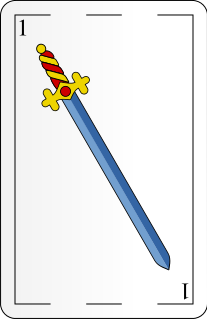
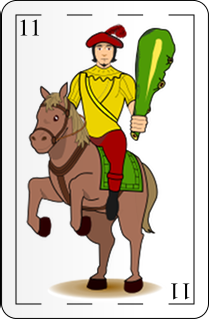
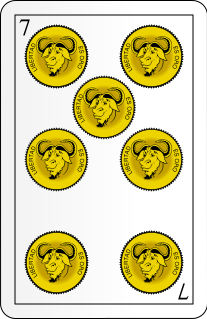
The 48-card Spanish deck is used: ace to nine plus the jack, knight and king of coins, cups, swords and clubs. The order is that of the numbers: the ace (1) is the lowest, and after the nines come the jack (10), the knight (11) and the king (12).
The Spanish deck has no red and black cards. So, where solitaire with the French-suited deck asks you to alternate colours, here you change suit.
The deal
The cards are dealt face down into columns, from left to right, and the last card of each column is left face up. The ones left over make up the stock.
| Deal | Classic Solitario | Spider |
|---|---|---|
| Columns | 7 | 10 |
| Cards in the columns | 28 | 46 |
| Cards in the stock | 20 | 50 |
- In Classic, the first column gets one card, the second two, and so on up to seven in the seventh.
- In Spider, the first six columns get five cards and the last four get four. The stock is dealt out afterwards in five rounds, ten cards at a time.
Classic Solitario: the columns
In the columns you build down one card at a time: on a card goes another one a number lower and of a different suit. On the seven of coins can go the six of cups, swords or clubs, but not the six of coins.
- You move the top card of a column, or a sequence of face-up cards that already builds down like that, as a whole.
- Only a king can go into an empty column, on its own or with the sequence on top of it.
- When a move uncovers a face-down card, it turns over by itself.
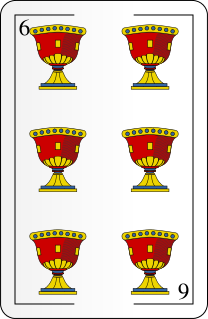 Allowed: the six of cups on the seven of coins, a number lower and of a different suit.
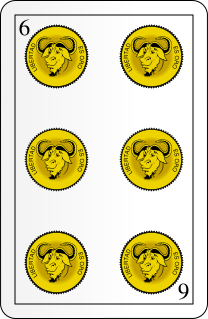 Not allowed: the six of coins is the same suit as the seven, and you have to change suit.
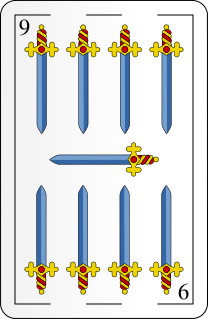
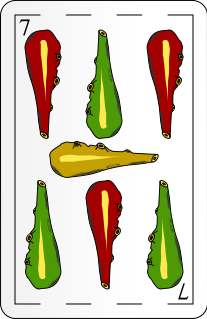 Not allowed: from the nine to the seven the eight is missing. You build down one card at a time, and in this deck there are eights and nines.
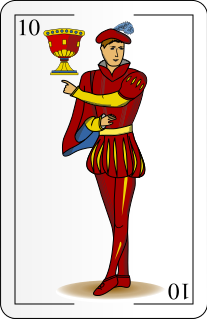
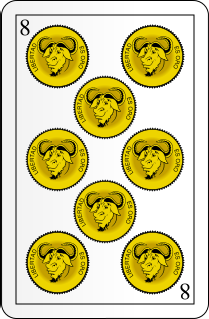 Allowed: the nine of swords with the eight of coins on top is an ordered sequence and moves as a whole onto the jack of cups.
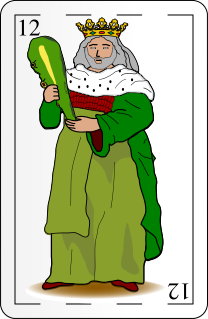 Allowed: the king of clubs takes an empty column.
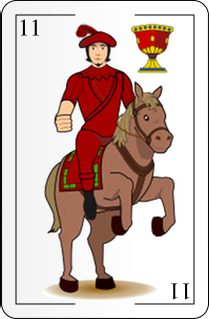 Not allowed: a knight cannot go into an empty column, only a king.
Classic Solitario: the foundations
There are four foundations, one per suit. Each starts with an ace and goes up one card at a time in its suit, up to the king.
- The top card of a column, or the one on the discard pile, goes up to a foundation one card at a time.
- The top card of a foundation can go back to a column, if it fits, but it cannot move to another foundation.
Classic Solitario: the stock and the discard pile
Cards from the stock go face up onto the discard pile. When you deal, you choose how:
- Draw one: one card goes across each time. It is the gentlest way to play.
- Draw three: three cards go across each time, and only the top card of the discard pile can be played.
When the stock runs out, drawing flips the discard pile over and it becomes the stock again. You can flip it over as many times as needed, and each flip counts as a move.
Classic Solitario: how you win
You win when all 48 cards are on the foundations. If the stock and the discard pile are empty and no card is left face down, the game is already won: “Finish” sends up the remaining cards, from lowest to highest.
Spider: the columns
In Spider you also build down one card at a time, but regardless of suit: any seven can go on the eight of swords.
- Several cards only move together if they build down one at a time and are all of the same suit.
- Any card, or any sequence that can be moved, can go into an empty column.
- When a move uncovers a face-down card, it turns over by itself.
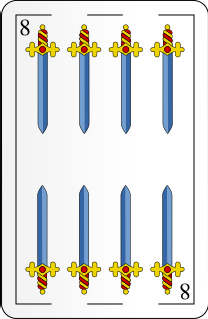
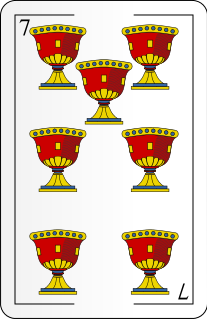 Allowed: the seven of cups on the eight of swords. In Spider the suit does not matter for building down.
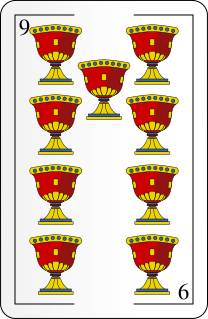
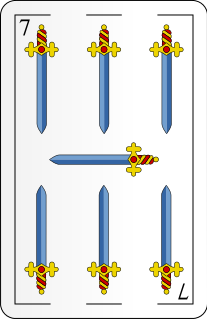 Allowed: the eight and the seven of swords are the same suit and move together onto the nine of cups.
- Not allowed: the eight of swords with the seven of cups on top do not move together, because they are not the same suit.
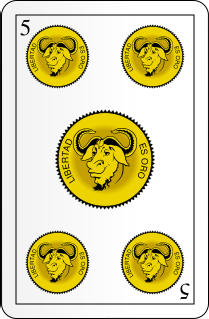 Allowed: in Spider, an empty column accepts any card, such as the five of coins.
Spider: dealing
Dealing puts one face-up card from the stock on top of each column. There are five deals in the whole game, and you make each one when it suits you.
You cannot deal with an empty column: you have to fill it first. The only exception is when there are fewer cards on the table than columns, because then there is no way to fill them all.
Spider: runs and how you win
When a column completes a run from king to ace, all in the same suit, it leaves the table by itself, whether you moved or dealt. If that uncovers a face-down card, it turns over.
You win when you complete all eight runs. In Spider there are no foundations or discard pile.
Spider: one, two or four suits
The 96 cards are always eight runs from ace to king. What changes is which suits they are, and the more suits, the harder they are to bring together:
- One suit: eight runs of swords. To start with.
- Two suits: four of swords and four of cups.
- Four suits: two whole decks, two runs of each suit. For the patient.
How you play at the table
- Tapping a card sends it to its best spot: its foundation if it can go up and, if not, the first column that accepts it (in Spider, preferably one of the same suit). A card on a foundation does not come down with a tap: you have to select it.
- Dragging a card or a sequence takes it where you drop it, and the table marks the spots where it is allowed.
- With the keyboard, Enter does the same as tapping, Space selects a card and Enter drops it where you are, Escape lets it go and Ctrl+Z undoes.
- Undo has no limit. The hint suggests a useful move: going up to a foundation or uncovering a card before drawing or dealing.
- New deal starts a fresh game with the same options (it asks for confirmation, because the current one is lost).
How it is played on Barajamos
These choices are fixed at the Barajamos table:
- The 48-card Spanish deck, with eights and nines: one in Classic and two in Spider.
- In the Classic columns you change suit, instead of alternating colours.
- The Classic discard pile can be flipped over without limit; drawing three, only the top card is playable.
- In Classic, an empty column only accepts a king; in Spider, any card.
- In Spider, 46 cards are dealt into the columns and 50 are left for five deals.
- The game is saved in the browser, with its time and its moves. It gives no chips and does not count towards the ranking.
Variants in other versions
With the 52-card French-suited deck, Klondike (the classic solitaire, also called Patience) alternates red and black cards, and some versions limit the passes through the stock or score points for each move. The French-suited Spider uses 104 cards: it deals 54 into the columns and leaves 50 in the stock. On Barajamos it is played with the rules on this page.
Glossary
- Column
- Each vertical row of cards on the table. You only play with the face-up ones.
- Sequence
- Several face-up cards in a column that build down one at a time and can be moved together.
- Foundation
- In Classic, each of the four piles, one per suit, that go from ace to king.
- Stock
- The face-down cards left to draw or to deal.
- Discard pile
- In Classic, the cards drawn from the stock, face up (also called the waste pile). Only the top one is playable.
- Run
- In Spider, the twelve cards of one suit, from king to ace, in order in a column. When completed it leaves the table.
- Hint
- A useful move the table suggests when you do not know how to go on.
- Klondike
- The international name for Classic Solitario.
Shall we try it?
You learn by playing. Start with Classic drawing one, or with Spider with one suit, and use the hint when you get stuck.